

Bundles work well for both eCommerce merchants and customers.
Customers like the discounted price benefits and added value, while merchants get opportunities to upsell, cross-sell, and try other profit-making tactics.
However, many merchants take bundle pricing too lightly. The result? They end up making pricing mistakes that hurt profits.
For instance, over discounting and miscalculating margins.
The best way to maximize ROI from bundling is to balance value perception with margin preservation.
In this blog, we explore the many ways to get pricing right for bundling.
Want to grow bundling revenue from your Shopify store? Try these bundle pricing strategies.
Understanding bundle pricing margins
Before we jump into bundle pricing strategies, let’s understand pricing margins, how to calculate margins, and Shopify tools that can help with it.
How to calculate product pricing margins?
To calculate Shopify bundle discounts correctly, it is important to keep in mind a few best practices for long-term success.
- Include all direct costs associated with the bundle. For example, cost of products, shipping, warehousing, storage, payment processing, etc.
- Another factor to consider to calculate product margins is to strategically group products for bundles in a way that it helps increase the average order value (AOV)
- Maximize the value perception of the bundle for customers by strategically selecting products and presenting price benefits. For example, mention the original price if products are bought individually compared to the bundle price
Set a margin threshold
One bundle pricing strategy that many experts recommend is to set a margin threshold. Meaning, set a bundle margin that does not go below a minimum acceptable figure. For instance, say you set a 20% margin threshold for each bundle. You can choose a margin threshold depending on your product type and industry.
A related strategy for Shopify bundle discounts is to set margin thresholds based on product sales volumes. For instance, high-volume products can have a lower margin threshold, and low volume, seasonal, or niche products can have a higher margin threshold. This strategy helps ensure AOV as well as average profit earning.
Example:

Tools useful for product pricing margins
There are multiple apps in the market for eCommerce discounting, tracking profitability, etc. For instance, Shopify and Shopify Plus have built-in basic features that help with product and bundle pricing. Additionally, you can integrate various third-party apps with Shopify.
Appstle Bundles & Discounts App is designed for Shopify and Shopify Plus stores to increase AOV with smart product combinations. The app helps increase products with targeted discounting. Along with the option to set up multiple bundle types and discount options, the app helps track bundle performance, so you can optimize it in real time.
How to calculate bundle pricing: step-by-step
Now let’s understand bundle pricing strategies through some examples.
Additive vs. perceived value pricing
Additive pricing for bundling involves adding prices of all individual prices and then offering a discount on it. For example, a coffee bundle that includes a coffee machine ($200), a coffee mug ($20), and a packet of coffee ($10) sums up to $230. It is sold at a bundle price of $20 discount at $ 210.
Additive pricing is easy and straightforward for brands to understand and communicate to customers. It clearly highlights the overall savings on a bundle. However, it may not be able to convey the added value customers perceive.
In the perceived value method, bundles are priced based on the customer’s value perception of the bundle. Here, prices of individual products are not added. This leads to profitable bundles. However, it is hard to understand the perceived value customers place on a bundle.
Example:
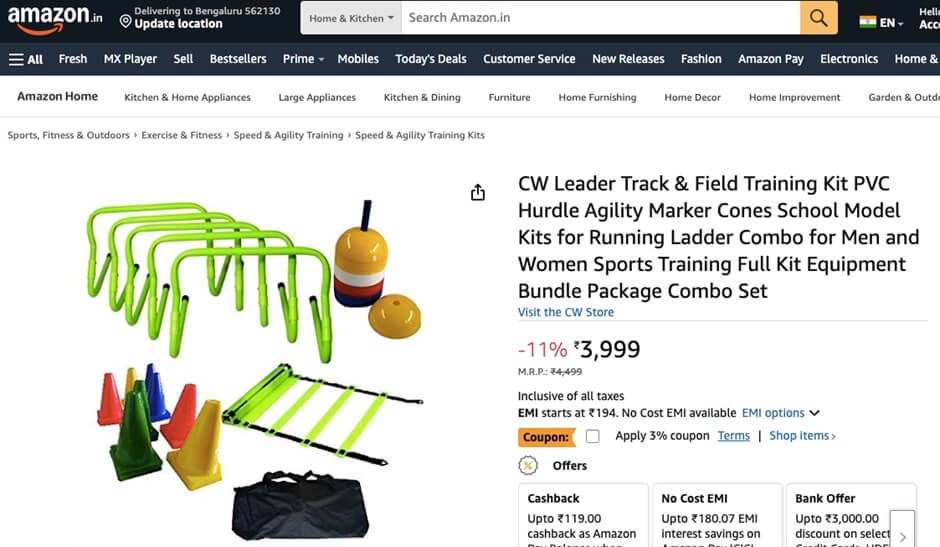
What to include in bundle pricing?
What are the factors to consider when working out your Shopify bundle discounts? Here are all the costs you must consider in order to reach a profitable price for your bundles and avoid over-discounting or charging less.
- Bundle packaging cost, such as boxes, protective material, larger boxes, etc.
- Shipping cost, such as dimensional weight
- Handling time, including picking and packing cost
- Quality control costs, such as inspection of products, bundles, or shipment
Effective bundle pricing strategies
Bundle pricing might seem simple and straightforward, but it isn’t. If not priced strategically, it can lead to loss. There are multiple strategies to price bundles, based on product type and industry. Here are some effective approaches to pricing bundles.
1. Tiered discounts based on cart value
Tiered eCommerce discounting involves setting dynamic discounts based on the items in the bundle. In simple terms, customers who buy larger bundles get more discount, and smaller bundles get lesser discount. This type of bundle pricing strategy helps increase AOV. It also helps preserve margins on smaller bundles.
Let’s understand tiered discounts through an example:
Tier 1: $100 to $200 bundle value – 10% discount
Tier 2: $200 to $300 bundle value – 15% discount
Tier 3: $400 to $500 bundle value – 20% discount
2. Psychological pricing
Psychological pricing works on the principle of influencing customers to make purchases via psychological tactics around pricing. For instance, how you present pricing, how you display discounts, and how you convey the value of a bundle to customers can lead to purchase decisions.
Let’s look at some psychological bundle pricing strategies:
1. Price display-based strategy
The way you display pricing and discount can influence customers’ perception. For instance, showing the price of individual products compared to bundle price can highlight savings. When customers see how much they can save, they tend to make purchases faster.
2. Odd-even and charm pricing
One of the most common pricing strategies that works well is charm pricing or odd-even pricing. For example, if a bundle costs $50, make it $40.99. This gives a perception to customers that they’re paying less, even though it’s just a slight decrease. Customers also tend to buy products that have prices ending in an odd number.
Example:

3. Flash vs. evergreen bundle discount
Another bundle pricing strategy plays around with time and urgency factors. We’re talking about flash and evergreen discounts.
Flash bundle discounts are offered for a short duration, creating urgency as these are for a limited time. With flash pricing you can offer higher discounts as this strategy works well for clearing inventory.
Evergreen discounts refer to consistent discounts that are available all the time. In this strategy, the discounts are moderate. This strategy focuses on long-term customer value and margin preservation.
Avoiding common bundle pricing strategy mistakes
While setting Shopify bundle discounts looks easy, small mistakes could hurt your pricing strategies. Let’s look at some:
- Avoid stacking bundle discounts with other promotional offers as this could turn into losses. For instance, if you offer bundle discount, first-time purchase discount, and another discount on the same purchase, you may end up with losses from such sales.
- Don’t underestimate fulfillment costs. For instance, bundle costs include packaging, storage, higher shipping weights, complex return processing, etc. Hence, always add a fulfillment cost to your bundles to avoid facing losses on these sales.
- Another bundle pricing strategy mistake to avoid is product mix mismatch. When you combine mismatched products in a bundle, the potential of its sales decreases. Hence, use customer purchase history data to identify products that would go well together in a bundle.
Enhance Shopify bundle pricing strategies with Appstle
It is clear from this Shopify pricing guide, that when planning bundle pricing strategies, one thing is critical – to calculate for end profit and only then experiment. If not, your bundle strategy might eat into your profits.
If you’re looking for a smart bundling tool for your Shopify store, you’re in luck with Appstle Bundles & Discounts. Appstle is designed to offer comprehensive solutions for all bundling requirements, drives sales, increases AOV, and profits.
Some of Appstle Bundles & Discounts App features:
- Create dynamic bundles for different business goals
- Uses data to create targeted and personalized bundles
- Seamlessly integrates with Shopify and third-party apps
- Offers 24x7x365 customer support to merchants
- Provides real-time analytics for better bundles optimization
Install Appstle Bundles & Discounts App on your Shopify store today!