

Pricing membership tiers is tricky. Underpricing to attract new members can eat into your pricing, and overpricing may impact the brand positioning.
Mistakes in membership tier pricing in Shopify stores can derail brands. It is essential to avoid mistakes. Moreover, if you notice flaws in your membership pricing strategy, it is critical to address them.
In this blog, you will learn about membership model mistakes to avoid and ways to address them.
TL; DR
- Discount-only strategies eat into profits, train customers to devalue products, and fail to differentiate your brand from competitors
- Too many tiers (4-6) overwhelm customers and complicate operations, while a single tier misses revenue opportunities from high-spending customers
- Each tier needs distinct perks like exclusive access, experience upgrades, or community involvement, not just incremental discounts
- Market conditions, customer preferences, and costs change over time; use A/B testing, performance analytics, and customer feedback to optimize rather than setting static pricing
- Benchmark competitors, calculate true delivery costs to protect margins, leverage customer psychology (loss aversion, status signaling), and ensure perceived value justifies the membership fee
Membership tier pricing in Shopify: Mistakes to avoid
From the various types of pricing and payment methods—one-time, recurring, hybrid—to evaluating the actual cost of perks for your business, and the value for customers, there are a lot of aspects you could go wrong with in memberships. Here are some mistakes you should avoid.
Mistake 1. Pricing based only on discounts
Offering discounts is the most basic marketing strategy, but it doesn’t work anymore. Customers are no longer impressed. Moreover, discount-based pricing strategies can create many problems for the business. Here are some reasons why discounts isn’t as good as it sounds:
- Discounts can end up eating profits, making heavily discounted membership pricing strategies unsustainable in the long run. Having lower margins on every transaction means you are decreasing your profits.
- Only discount-based perks train customers to devalue products, and eventually, they perceive the discounted prices as the real prices. This psychological effect may be impossible to reverse.
- Offering discounts is a common membership strategy that every brand does. It fails to make your membership program stand out, unless you have other unique perks attached with your membership program.
Mistake 2. Too many or too few tiers
Finding the right number of membership tiers is also a critical factor, as too many or too few tiers can create challenges for membership strategies.
- When there are too many tiers to choose from, customers often feel confused. For instance, offering four to six membership tiers can overwhelm customers. First, they might spend a lot of time and energy comparing the tiers. And second, they might overthink and may not be able to decide which tier they’d like to sign up for. This can have a negative impact on the conversion rate.
- Moreover, offering too many tiers can lead to operational complexity for the brand. Each tier might require a different process, customer service, and communication strategy. This increases workload as well as complexity.
- Conversely, offering just one single tier steals away opportunities to engage customers. Customers do not experience the excitement that they find with multiple tiers. Moreover, customers who have a higher spending capacity might end up with a membership program with a lower denominator.
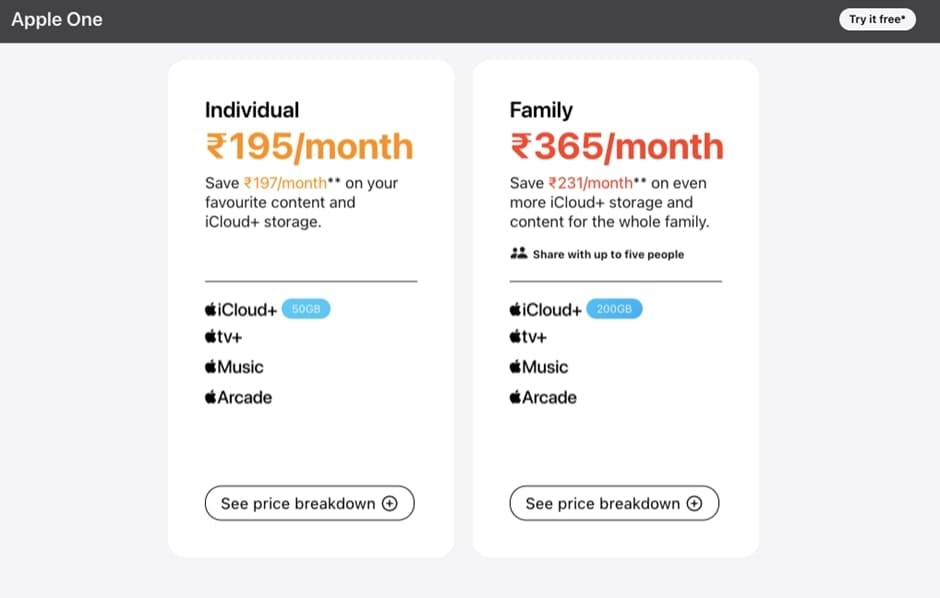
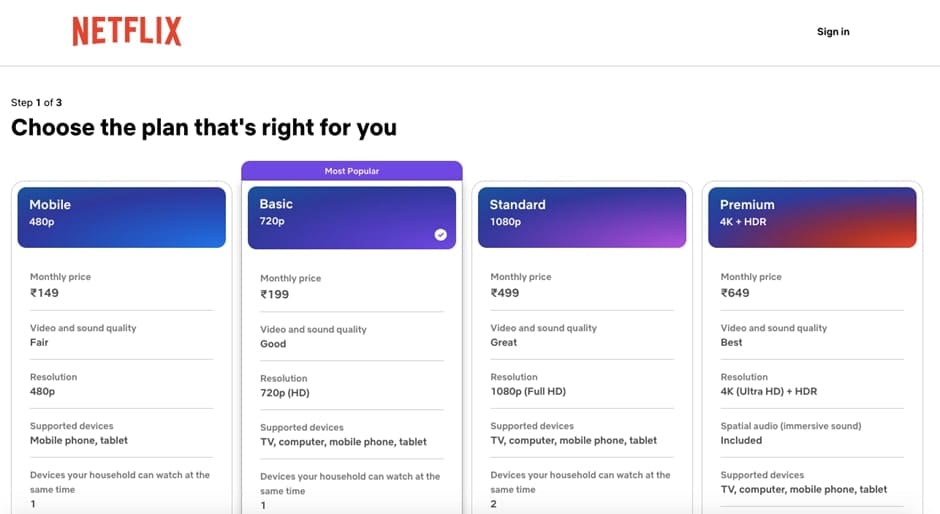
Example: While Apple offers just two plans, Netflix offers four
Mistake 3. No clear value differentiation
One of the biggest mistakes in membership tier pricing in Shopify stores is not creating different value propositions for each tier. Not creating clear value differentiators for each tier can leave customers confused. They may not see any benefits of upgrading to higher tiers. And this can lead to low lifetime value.
Here are some signs of weak differentiation:
- Each tier offers an incremental discount. For example, 5% more discount with each progressing tier
- Ambiguous perks, such as exclusive content, or special offers. Generic offers with no clarity
- Offering perks to higher tier members that non-members or lower tier members can also access. This decreases the sense of exclusivity
So how can you create strong value differentiation?
1. Access-based perks: Offer exclusive products, limited-editions, or pre-order facility to higher tier members. Make sure you do not offer this benefit to members of any other tier or non-member.
2. Experience upgrades: Provide perks such as dedicated customer support manager, priority support, free consultations, invitation to members-only experiences, etc. These exclusive experiences should go beyond transactional discounts.
3. Community and influence: Allow top-tier members to participate in product development surveys, voting for new product releases, inclusion in brand advisory councils, etc. This makes members feel more connected to the brand, turns them into stakeholders, and builds stronger emotional connections.
4. Increase convenience: Enhance the convenience factor in higher tiers. For example, offer free faster shipping, hassle-free returns, flexible subscription management, etc.
Mistake 4: Not testing pricing
Setting and forgetting about membership tier pricing in Shopify stores is another mistake that costs brands. There are many factors that can affect the initial pricing you set for membership tiers. Hence, it requires testing and iteration. Here’s why static pricing does not work:
- The market changes constantly. Customers’ priorities also change. Inflation can impact your membership profitability. Product costs can increase. Your competitors might launch new programs or revise pricing. In these situations, if you do not revisit and optimize your membership pricing, you might struggle to have a sustainable pricing system.
- Different customers prioritize different benefits. It is important to monitor which customers prefer what benefits. Observe what perks are used, which aren’t, and which membership tiers are more popular. A one-size-fits-all approach does not work in membership pricing.
So, how can you create a framework for testing membership pricing?
1. Analyze existing tier performance: Monitor the performance of your existing membership tiers. For instance, track patterns, such as which tiers have the highest sign ups, where do members upgrade or downgrade, what’s the lifetime value by tiers, retention rate in each tier, customer support requests in each tier, etc. This will help you understand the plus points and drawbacks in each tier.
2. Segment-based testing: Create member segments and test different pricing for each segment. For example, new customers might see introductory pricing, while old ones will see standard pricing. You can use Shopify’s customer tags and conditional logic for this.
3. A/B testing for tiers: Conduct A/B testing for different configurations. For example, try different pricing for two-tier membership programs, and a different pricing structure for three-tier membership plans. Run A/B tests for different perks as well.
4. Survey qualitative feedback: Request members to fill surveys and questionnaires to understand why members like or not like things. Find out what they expect and what competitors offer that they’d like in your membership program.
5. Monitor key metrics: Track metrics, such as adoption rate, upgrade rate, downgrade rate, churn rate, average order value, purchase frequency, customer lifetime value, and support cost per member. Appstle Membership App has built-in analytics that makes it easy to track tier performance.
How to strategically price Shopify membership tiers
Setting up strategically priced membership tiers requires a data-based approach and systematic planning. Here’s how to price membership tiers for the best ROI.
1. Benchmark competitive positioning
Study competitors in your industry to understand their pricing strategies and why customers like its memberships. Here are some details to look for:
- What are their pricing points?
- What are the perks they offer in each tier?
- Identify gaps that your membership tiers can fill
- How can you position your membership plan distinctively?
2. Calculate your value delivery costs
Yes, you want to offer many perks, but it’s essential to calculate the cost of those perks, and to ensure it doesn’t eat into your profits. Here’s how you can calculate the delivery costs:
- Calculate the total cost of offering each perk. For instance, free shipping might cost $5 per order, and priority customer support might involve the cost of additional support personnel.
- Build a simple membership model. Subtract the cost of delivery, discount from the monthly membership fee to know your net membership profit margin.
- Ensure each tier provides positive margins and that higher tiers offer more margins.
3. Align perks with customer psychology
To design effective Shopify membership tier pricing, lean into customer psychology. Here are some psychological factors to consider:
- Loss aversion: Perks such as exclusive access make members feel they’re getting special privileges
- Status signaling: Have tier names that make members feel like they’re part of high-status groups. For example, VIP, Premium, Insider, etc.
- Reciprocity: Include surprise perks that create stronger bonds and makes customers respond with greater loyalty
- Progress mechanics: Create tiers with upgrade paths that are easy to achieve for customers
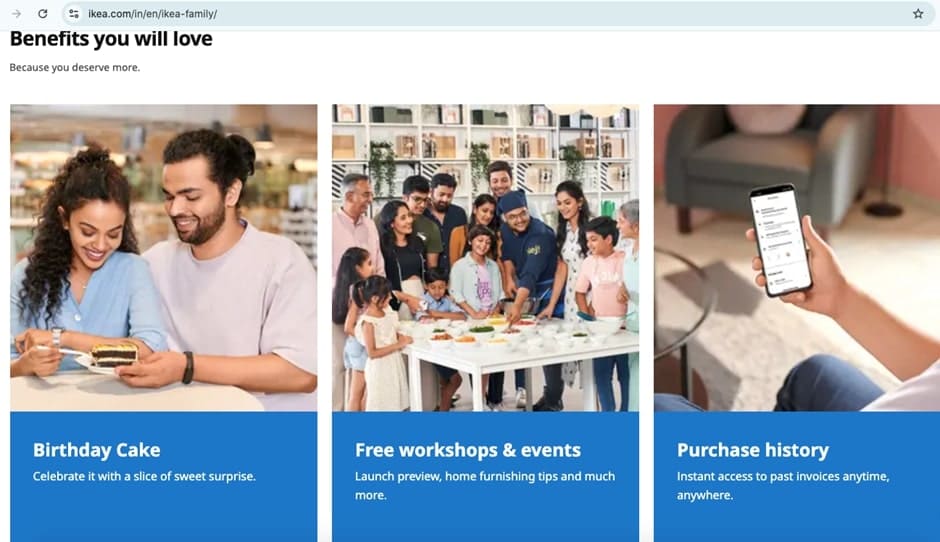
Example: Ikea membership offers transactional discount, and experiential perks.
4. Price for perceived value
Find out what customers think is fair value for the benefits offered in each tier. For instance, a membership plan that costs customers $150 a year and saves them $300 a year has a better perceived value.
For premium tiers, the perceived value comes from exclusivity and experiential perks. For instance, personal one-on-one styling sessions and VIP access to new collections.
5. Use technology to test and optimize
Appstle Memberships App provides a comprehensive set of features for designing, testing, and optimizing membership tiers. The app has the following key features:
- Test different pricing structures
- Track performance analytics by tier
- Automate benefit delivery
- Easy integration with the existing Shopify store
- Create sophisticated tier structures with varied billing cycles and trial periods
- Offer different benefit combinations in each tier
- Collect and analyze real-time data
6. Create clear upgrade incentives
Create clear upgrade paths to make it easy for members to upgrade to higher tiers. Highlight what lower tier members are missing out on and encourage them to upgrade. Create time-sensitive upgrade promotions. You can also offer first-month discounts on higher tiers to increase upgrades.
How will you design your membership tier pricing for Shopify?
Strategic membership tier pricing for Shopify stores can set you up for long-term success. However, you have to avoid making mistakes that can harm your membership pricing strategy.
Over discounting, offering too many or too less tiers, weak value proposition, and static pricing are some of the mistakes that cost brands a lot. By focusing on value, customer-first approach, and continuously optimizing, you can ensure a successful Shopify membership program.
To have a strong foundation and drive success, integrate Appstle Memberships App into your Shopify system.
Install Appstle Memberships App on your Shopify store today!