AI has immense potential for eCommerce. From marketing to design to content to sales – there are AI tools for every process.
While an increasing number of Shopify stores are integrating AI into their systems, many fail to maximize its applications.
In this blog, we look at ways to use AI for Shopify sales growth, across your Shopify store processes, to enhance customer engagement, sales, and profitability.
Read on!
AI application for Shopify stores
Customer-facing: To drive engagement and conversion
One of the biggest advantages of AI is to understand your customers better based on data and analysis. This helps with AI-powered personalization, higher engagement and conversions. Here are some strategies to use AI for customer-facing processes.
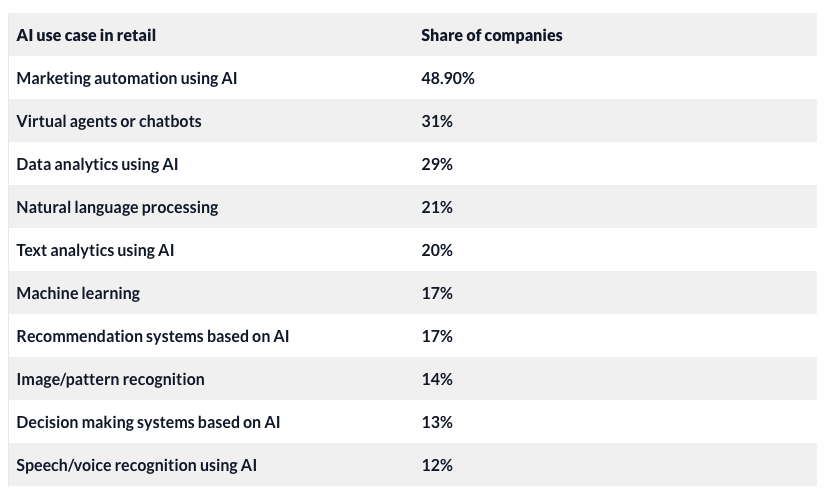
Here are some statistics on the various use cases of AI in retail companies.
1. Personalization and product recommendations
AI has changed the way brands interact with customers. While earlier, brands interacted with customers to understand their needs and preferences, now, AI does it for brands. Then, brands interact with customers by sharing personalized recommendations and telling customers what they must purchase.
Here’s how to integrate AI-powered personalization and recommendations:
- To track customers behavior on the website
- Collect data about past purchases, interests, preferences
- Analyze the data to draw patterns
- Get a better understanding of customers
2. Chatbots and virtual assistants
Customers can have different kinds of requirements from brands. Some may need assistance with shopping, while some might have issues that need the brand’s attention.
Their first instinct is to reach out to customer support. Ecommerce brands are now using AI chatbots and virtual assistants to provide customer service. 31% of eCommerce companies use virtual agents or chatbots.
Here’s how using AI-based chatbots and virtual assistants for eCommerce stores can help in many ways. It improves:
- Efficiency: Prompt and relevant responses to customers
- Scalability: Attend to multiple customers at the same time
- Customer satisfaction: Prompt and effective support lead to customer satisfaction
- Data collection: Collect and analyze data easily via AI tools
Here are some use cases for AI for Shopify sales growth:
- To answer basic questions
- Offer shopping assistance
- To resolve customer issues
- Guide customers for rewards, points, offers, etc.
- Provide 24/7 AI-enhanced customer support and assistance
3. AI for dynamic pricing and smart discounts
AI-based dynamic pricing adjusts prices of products and services in real-time, based on potential customer actions. It has changed the way eCommerce businesses sell their products and services.
For example, when the demand for a particular product is low, maybe due to seasonal change, AI automatically reduces its price to drive more sales. Dynamic pricing helps increase sales and revenue, customer experience, inventory management, and adds competitive advantage.
Here’s how you can use AI for Shopify sales growth through dynamic pricing:
- Use AI to adjust pricing based on competitor pricing, so you can offer the best price
- Change pricing based on real-time demand and supply
- Change pricing based on customer actions and behavior to encourage more sales
4. AI-based email and SMS marketing
Consistent communication is a must to keep customers engaged. Ecommerce stores are using AI to set up automated systems for email and SMS marketing.
AI can help speed up email and SMS campaigns, ensure consistency, timely communication, and free up marketing teams’ time with automation.
Here are some ways to use AI for email and SMS:
- Segment email lists with data such as demographics, purchase history, and engagement levels
- Use AI to determine optimal email open time to decide send time
- Create personalized emails using AI
- Create content using AI tools
- Conduct A/B testing using AI
- Automate emails and SMS with AI tools
5. AI-enhanced visual search and AR
AI-based search and augmented reality offer many advantages to eCommerce stores. For instance, it offers a faster and more intuitive experience. Customers feel instant satisfaction, and it can enable a personalized shopping experience.
Here are some ways you can use AI-based AR and visual search:
- Use AI to analyze past purchase data and offer customized recommendations
- Use visual search to match products with images uploaded by customers to understand their preference and taste
- Use AI for Shopify sales growth to enable virtual try ons, for instance, for accessories, clothes, etc.
Here’s an example of Amazon’s Shop the Look AI feature.

6. AI-driven upselling and cross-selling
Upselling and cross-selling are effective strategies to increase sales. However, unlike physical stores where a sales representative can personally recommend products for upselling or cross-selling, for online stores, you can depend on AI tools to help you upsell.
Here’s how to incorporate AI-driven upselling and cross-selling:
- Automate product recommendation based on customers’ recent purchase
- Upsell and cross-sell products based on other customers’ purchase patterns
- Bundle and combine products and offer dynamic discounts based on customer behavior
7. AI for loyalty programs
If you have a loyalty program on your Shopify store, you have to ensure your loyal customers are consistently happy and engaged. And this is where you can employ AI to enhance your Shopify loyalty program.
For instance, you can use AI to understand your loyalty members’ preferences and offer them personalized loyalty incentives. Your AI tools can be set up to provide special 24/7 assistance to loyalty members. Moreover, you can also use AI to optimize the rewards structure for your loyalty members, ensuring retention and higher customer longtime value.
Business operations: For efficiency and profitability
Most eCommerce businesses can benefit from using AI for customer-facing as well as internal and business operations perspectives. Here are some AI applications for business operations that can lead to higher efficiency and profitability.
11. AI for inventory and demand forecasting
AI has made inventory management easy, accurate, and predictive. With the help of AI tools, businesses can easily analyze sales data, sales patterns, market trends, and more. This data analysis and insights can be used to forecast demand and ensure proper inventory management.
For instance, an eCommerce fashion retailer can use AI to analyze purchase patterns based on locations and regions. AI can help predict the styles that sell more in specific locations, and automatically adjust the inventory.
Ways to use AI for Shopify sales growth based on inventory management:
- Analyze data related to reorders to predict inventory needs
- Identify slow-selling products before they become deadstock
- Use AI for dynamic pricing based on demand
12. AI for supply chain and logistics management
Supply chain and logistics management can be quite complex. It has many aspects that have to work in sync; for instance, different locations may require different delivery services, real-time updates due to traffic or weather conditions, etc.
Businesses have proven that the use of AI for Shopify sales growth for supply chain and logistics management can bring efficiency, higher performance, and seamless operations.
Here are some ways to use AI for supply chain and logistics:
- For customer support related to logistics and delivery
- Identifying shipment delays and notifying customers
- Real-time route optimization
- Early risk detection for disruptions
13. AI-based order fulfillment and automation
Another crucial part of eCommerce stores is warehouse operations and last-mile delivery. And AI is helping streamline these processes, too. For instance, Amazon uses robots at its fulfillment centers to pick and pack orders. The computerized system identifies products and ML optimizes the processing time.
Some ways you can use AI for order fulfillment:
- Automate warehousing and inventory placement based on order frequency prediction
- Computerized quality control while packaging
- Dynamic delivery time and schedule based on real-time conditions
14. AI for subscription management
Running subscription models involves many processes and tasks. Each of them are critical and have to work in sync with the others. This is where AI can help you. From managing your subscription plans to updating them to cancellation management, payments, and inventory management, AI can help you with all these tasks, and more.
In addition to these operations-related processes, AI can also help with customer-facing processes. For instance, personalized recommendations, AI-based dynamic pricing and discounts, AI-enhanced customer support, etc.
With AI, you can automate subscription management and recurring billing:
- Automate adjusting delivery schedules based on consumption patterns
- Identify cross-selling opportunities within subscription offerings
- Identify at-risk subscribers before they cancel subscriptions
- Optimize pricing tiers based on usage analytics and willingness-to-pay modeling

15. AI for customer segmentation and insights
With AI, retailers can conduct advanced segmentation based on behavior patterns, preferences, and more. For instance, Sephora uses AI systems to analyze customers’ purchase history, and browsing behavior to create customer segments.
Some ways to use AI for Shopify sales growth via segmentation and insights:
- Use AI to identify high-value customer segments with predictive lifetime value analysis
- Detect customer behavior patterns to identify their needs before they express it
- Create dynamic segments that automatically update as customer behavior changes
16. AI for A/B testing
AI can help you identify customer patterns that you may miss otherwise. For instance, you can run A/B tests of different kinds for multiple campaigns at the same time. AI-based analysis can help you with A/B testing at scale.
Here are some use cases for AI A/B testing:
- Test communication variants for campaigns
- Personalized testing that shows different variations to different segments
- AI-generated test hypothesis based on user behavior analysis
- AI testing for continuous adjustments based on real-time performance data
17. AI for SEO and content optimization
Digital marketing and SEO are key for eCommerce businesses to attract customers. AI tools can help with various processes related to SEO and content. For instance, to create content, optimize it, and to distribute it to the right potential audience.
Here’s how brands are using AI for Shopify sales growth for content and SEO:
- Use AI for keyword research and to identify trends
- Automate content optimization by using AI to suggest improvements
- Conduct content gap analysis using AI
- Automate internal linking strategies maximizing page authority
18. AI for fraud detection and risk management
With an increase in online fraud, it’s a must for eCommerce retailers to set up fraud detection systems and strategies. For instance, businesses can employ deep learning algorithms that can analyze multiple variables for every transaction to identify fraudulent patterns.
Here’s how you could implement risk management with AI:
- Identify account takeover attempts via login behavior
- Detect suspicious purchase patterns based on customers’ past behavior
- Identify fraudulent shipping address changes
- Assess transaction risk within seconds
How to get started with AI for Shopify sales growth?
There’s intense competition in the eCommerce market. But that shouldn’t scare you if you integrate the right AI tools on your Shopify store to help you with marketing and operations.
Ensuring your Shopify tools have AI features and the ability to continuously advance with the evolving AI technologies is the best way to get started.
If you’re exploring Shopify tools that can help you with AI capabilities, explore Appstle for subscription and loyalty apps.
Install Appstle Subscriptions App and Appstle Loyalty & Rewards App on your Shopify store.