For small Shopify stores, managing product bundles is simple.
But for enterprise brands bundling products from multiple categories, markets, and channels can be complex.
Apart from the challenge of creating thoughtful and appealing bundles, the challenges also include managing thousands of bundle combinations at the same time, maintaining inventory accuracy, customer experience, profitability, and more.
In this guide, you’ll learn how enterprise product bundling strategies for Shopify brands and the systems to make it work.
A quick look at the key ideas in this article
- Bundling gets exponentially harder at scale. A few SKUs and bundles are easy to manage by hand, but thousands of SKUs can’t keep up.
- The biggest hidden challenges are: real-time inventory sync (one SKU can live in hundreds of bundles), consistent pricing logic, propagating product updates across bundles, reporting on which bundles actually drive revenue, and the sheer merchandising workload of managing bundles manually.
- Build bundle rules instead of individual bundles.
- Use dynamic bundles that adapt to inventory and customer choice, not fixed combinations.
- Organize your catalog into bundle-friendly collections with clear tagging and hierarchy.
- Use customer behavior data (frequently bought together, repeat purchases) to guide bundle creation.
- Automate discount and pricing logic with tiered/volume/collection-based rules
- Connect bundles across channels (online, POS, retail, wholesale) for consistency
- Continuously measure performance, conversion rate, attach rate, AOV, revenue, and margin
- Bundles aren’t just an AOV tool. They also drive product discovery, inventory clearance, new product adoption, customer acquisition (starter kits), personalization, and cross-category expansion.
- Enterprise bundling requires flexible rule-based logic, real-time inventory sync, automated pricing, POS support, advanced analytics, and cross-channel consistency; spreadsheets and manual processes break down at scale.
- Before scaling, ask: Can your platform handle thousands of combinations? How much bundling is still manual? Are bundles tied to live inventory? Do you know which bundles are actually profitable?
- Success isn’t about creating more bundles. It’s about building a scalable system (rules, automation, data-driven personalization) that grows with the business. Tools like Appstle Bundles & Upsells are built to handle this automation end-to-end.
Why does bundling become more complex at enterprise scale?
When a store is small with just 20 SKUs and five bundles, it’s easy to manage everything. From choosing product combinations to pricing to monitoring performance.
But imagine thousands of SKUs across multiple collections, marketing, and fulfillment locations? A large number of products can lead to various kinds of complexity.
- Combination explosion: Every new SKU added to the inventory multiplies the number of possible bundles that it can be a part of.
- Inventory dependencies: A single SKU might be a part of hundreds of different bundles, so one stockout can affect the entire merchandising plan.
- Pricing complexity: Different bundles may need different discount logic, which has to stay consistent across bundles and markets.
- Merchandising complexity: Deciding which bundles to promote, and when, becomes an ongoing complex task rather than a one-time setup.
The challenges of managing thousands of enterprise product bundling combinations
As businesses scale, bundling may pose many challenges. Here are some of the most common challenges you should look for in your Shopify bundling business.
Inventory synchronization
A single SKU can belong to hundreds of bundles at once. If that SKU sells out, every bundle containing it needs to be updated, disabled, or reconfigured. This has to be done instantly, in real time and through an automated system, not manually.
Pricing management
When bundles are built manually, discount logic tends to become inconsistent. One bundle might be discounted 15%, another 20%, with no clear reasoning. At scale, this inconsistency erodes both profitability and customer trust.
Product updates
A single product change, for example, a new price, a discontinued variant, an updated image, can ripple across dozens or hundreds of bundles that include it. Without a system to propagate that change, bundles quietly go stale.
Reporting complexity
With thousands of bundle combinations live at once, understanding which bundles are actually driving revenue (versus just existing) becomes genuinely difficult without dedicated analytics.
Merchandising workload
One of the biggest challenges is that manually creating and maintaining bundles simply becomes impossible past a certain scale. A merchandising team can build and maintain dozens of bundles by hand. They cannot build and maintain thousands.
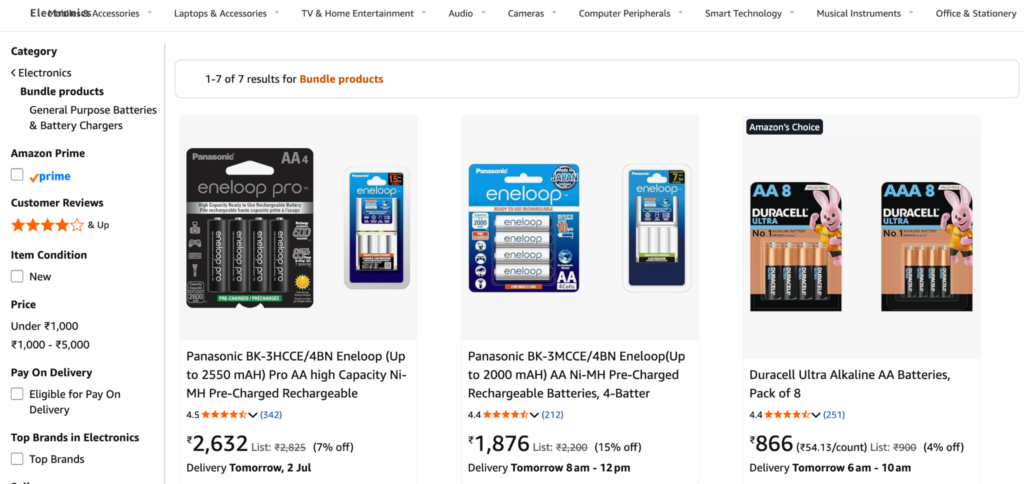
7 strategies for Shopify enterprise product bundling
Here are seven strategies you can apply for efficient Shopify bundle management.
1. Build bundle rules, not individual bundles
Automating bundle creation rules can reduce complexity. For instance, instead of creating three bundles from scratch, define rules that automatically create bundles. For example:
- Any 3 products from collection A
- Any 4 products from category B
- Any 2 products from the same product line
Instead of manually building and maintaining hundreds of individual product groupings, one rule can generate hundreds of valid bundle combinations automatically. This automated system of creating bundles can help you scale without added manual processes, reduce ongoing maintenance, and adapt automatically as the catalog changes.
2. Use dynamic bundles instead of fixed product combinations
Dynamic bundles are created in real time based on customer behavior. Rather than fixed sets of products, dynamic bundles can:
- Adjust automatically based on catalog changes
- Let customers select the products they want in the bundle
- Adapt to real-time inventory availability
Common formats include build-your-own-box offers, mix-and-match bundles, and collection-based bundles where any product from a defined group gets added to a bundle. This shifts the bundle from a fixed offer into a flexible tool that is more relevant to customers and the current catalog.
3. Organize products into bundle-friendly collections
For dynamic enterprise product bundling to work effectively, it is important that the catalog is planned and structured in a systematic manner. For this, brands need to create clear collection structures, consistent product tagging systems, and a defined product hierarchy. Here’s how this structure helps:
- Bundles can be created based on collection or tag membership rather than manual product lists
- Automation rules become easier to write and maintain
- Merchandising teams can launch new bundle campaigns faster
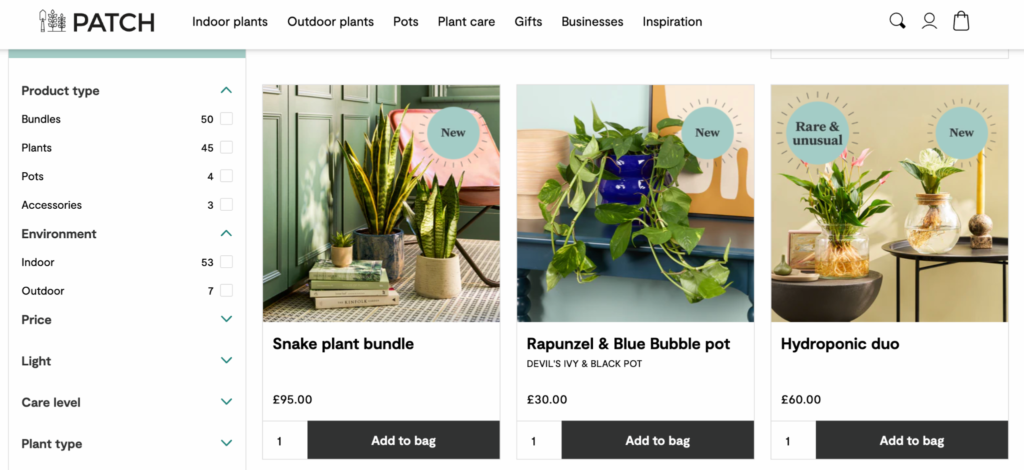
4. Use customer behavior to determine bundle opportunities
Creating a strong data collection and analysis strategy for enhancing your enterprise product bundling strategy can ensure effectiveness and relevance when market trends change. For instance, when you gather data on frequently-bought-together patterns, repeat purchase behavior, and cross-category purchase patterns, you can keep the bundles more relevant.
Here’s how creating bundles based on customer data makes a difference:
- Create bundles based on evidence rather than guesswork
- It makes personalized bundling possible, for instance, offering different bundle suggestions to different customers based on their own purchase history
- Data can help drive dynamic recommendations that update as customer behavior changes
5. Automate bundle discount and pricing logic
For enterprise brands that have thousands of bundles, manual price-setting is almost impossible. Moreover, it is a recipe for inconsistency and errors. Therefore, enterprise brands use smart bundling tools, such as Appstle Bundles & Upsells to build rules-based pricing systems.
Some of the rules for bundle pricing systems may be: Tiered discounts, volume discounts, and collection-based discounting rules.
Let’s look at some benefits of automating bundling logic.
- Pricing stays consistent across thousands of bundles
- Fewer manual pricing errors
- Easier to scale new bundle campaigns without rebuilding pricing logic each time
6. Connect bundles across channels
Most often, enterprise brands have multiple sales channels. For instance, Shopify stores, Shopify POS, physical retail stores, and wholesale. Bundling strategies need to stay consistent on all channels.
This means thinking in terms of omnichannel merchandising and unified promotions. The same bundle logic and pricing rules apply whether a customer is shopping online or in a physical store. Disconnected bundle strategies across channels create confusion and inconsistent pricing, which harms customer trust.
7. Measure bundle performance continuously
Monitoring and measuring enterprise product bundle performance is key for ongoing success. Here are some of the metrics to measure:
- Bundle conversion rate
- Bundle attach rate
- Impact on average order value (AOV)
- Revenue contribution
- Margin contribution
The goal isn’t to maximize the number of bundles in the catalog — it’s to continuously identify which bundles are actually working and optimize or retire the ones that aren’t. Bundle quantity is a vanity metric; bundle performance is what matters.
How enterprises use bundles beyond average order value (AOV)
Most brands think of bundles as a strategy to increase AOV. However, there are many other ways bundles can positively impact your business. Here are some:
- Product discovery: Introduce customers to new or lesser-known products by pairing them with bestsellers.
- Inventory management: Move slow-selling or excess stock by bundling it with high-demand items.
- New product launches: Drive adoption of new products by bundling them into existing purchase paths.
- Customer acquisition: Use starter kits or introductory bundles to lower the barrier to a first purchase.
- Personalization: Offer custom bundle experiences tailored to individual customer behavior.
- Cross-category expansion: Increase product penetration by encouraging customers to buy across categories they wouldn’t normally shop.
The tech stack you need for enterprise bundle management
Here are the tech and digital capabilities that you require for your enterprise product bundling strategy.
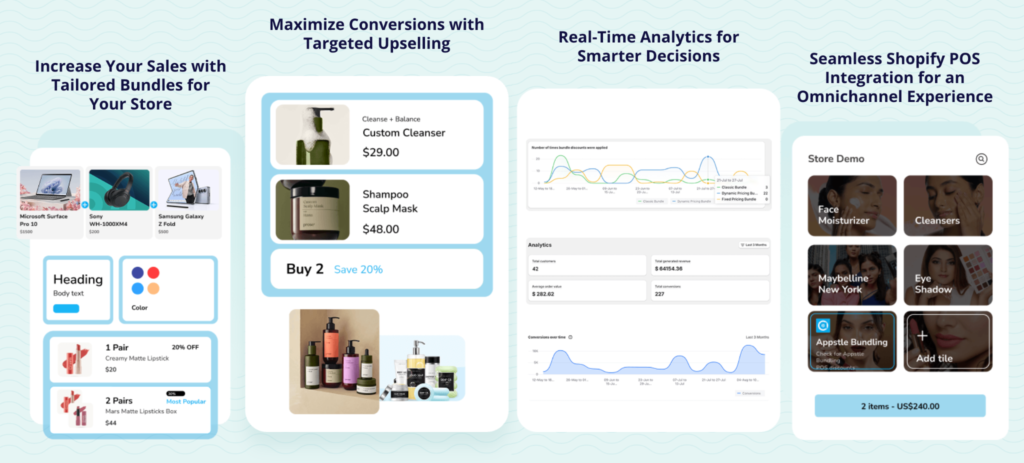
- Flexible, rule-based bundle logic
- Dynamic bundle creation and updating
- Real-time inventory synchronization
- Automated pricing and discount logic
- Shopify POS support for in-store consistency
- Advanced analytics and reporting
- Support for high-volume transactions
- Consistency across every sales channel
Questions to answer before scaling bundles in your Shopify store
First, get a sense of how much of your bundling happens manually, and which are the processes that can be automated via a bundling app. Understand the capability of your current eCommerce platform – can it support thousands of bundle combinations? If not, what apps or technology support would you require for that?
Apart from that, you must know if your bundles are connected to live inventory data. This means, will bundles change in real time based on sales and demand? Will your bundles be available only on your Shopify store or on other offline channels as well? These are some of the basic questions to begin with, before you get started with your enterprise product bundles.
Summing up
A successful enterprise product bundles strategy is not just about creating bundle volume. It is more about setting in place a system that will support your business in scaling bundles as your business grows.
For a successful bundling strategy, create flexible rules, automate pricing and inventory logic, use customer data to create dynamic bundle experience, increase AOV and drive revenue automatically through a robust bundling app, such as Appstle Bundles & Upsells.
Appstle Bundles & Upsells allows you to create multiple bundle types, automates discounts and pricing logic, tracks bundle performance in real-time and creates dynamic bundles, etc.
Install Appstle Bundles & Upsells App in your Shopify store today!