

The eCommerce space has noticed an uptick in subscriptions all through 2023.
Ecommerce brands across industries — from grocery to fashion to liquor — are offering subscriptions to enhance customers’ shopping experience.
Within subscriptions, there’s one model that retailers are talking about a lot — the tiered subscription model.
If you want to learn about what is a tiered subscription model, its benefits, and how it could help your Shopify business grow, this is your go-to guide.
1. Why tiered subscription models matter more in 2026
Subscription businesses are evolving, catering to the needs and preferences of various customer segments. And in 2026, they’re going to get more sophisticated. Here are some trends to look out for.
1. Shift from flat subscriptions to value-based access
While the one-size-fits-all approach that offered the same features to subscribers worked earlier, in 2026, consumers are looking for more value. With this shift, eCommerce brands are creating subscription tiers that address the usage patterns of different customer segments.
- Casual users get basic functionalities
- High-end tiers get premium features and exclusive experiences
- Brands offer multiple entry points via different tiers
- Customers can self-select tiers that match their perceived value
- This creates a more sustainable revenue model
2. Rising customer expectations for flexibility and status
Unlike earlier when customers were happy with just access to subscription service, now, customers expect more control, flexibility, and status from their subscriptions. Tiered models provide these. Subscribers can upgrade, downgrade, and customize their subscriptions based on their usage and requirements.
Moreover, premium tiers that offer high-value benefits, community experience with other members of the tier, etc., also become a status symbol. Tiered subscriptions support identity creation and social currency.
3. Tiered models as a response to subscription fatigue
On an average, an individual customer is signed up to 10 to 15 subscriptions at any given time. It’s hard to keep track of so many subscriptions, renewal dates, reward points, offers, etc. Subscription fatigue leads to cancellations. This is something that tiered subscription models can solve. Here’s how:
- Tiered models allow subscribers to downgrade to free or basic tiers
- It reduces financial pressure on subscribers
- Tiered models maintain customer relationships
- Tiered models prove to be effective retention strategies
4. Tiered subscriptions increase CLTV
Tiered subscriptions also help increase customer lifetime value (CLTV). Tiers provide a path that encourages customers to increase their spending in order to climb to higher tiers. Here’s how tiered subscriptions help increase CLTV:
- Brands can give customers an easy entry point
- Identify when subscribers are ready to move to higher tiers
- Tiered models help with segmentation and personalization, enabling testing pricing
- It helps with testing bundles, and cater to price-sensitive and premium customer segments
What is a tiered subscription model in eCommerce?
A tiered subscription model is a pricing strategy. This kind of a subscription model involves categorizing the pricing of products or services into multiple levels or tiers. Each tier or level offers different features and benefits at different price points.
Tiered subscriptions allow customers to choose the tier that best matches their budget and needs. This model also offers flexibility to customers and scalability to eCommerce brands.
Typically, SaaS and retail eCommerce brands have three subscription plans. Some have two or four.
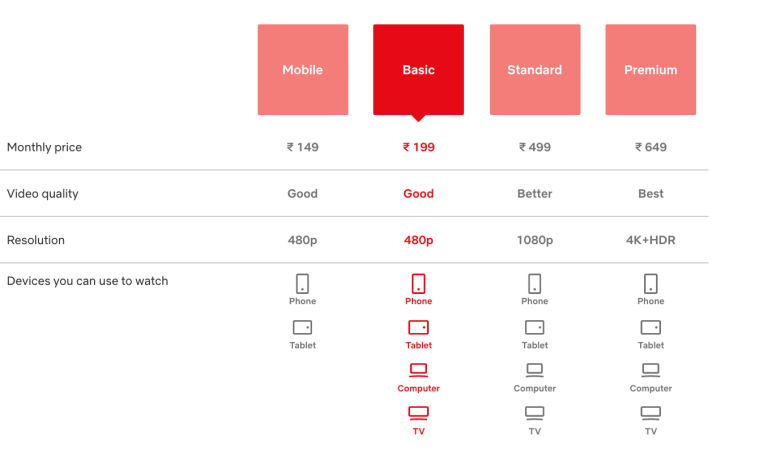
A good example of tiered subscription models is Netflix. The streaming platform offers different subscription plans based on the number of users that can use it.
Here’s an image showing Netflix subscription tiers for India:
Tiered subscriptions vs flat subscriptions: What’s changed
Let’s understand how tiered subscription models are different from flat subscriptions and why tiered are more favorable to customers.
1. Flat subscriptions operate on a one-size-fits-all principle
Flat subscriptions offer the same products and services to all subscribers. It is based on simplicity. All subscribers pay the same price and receive the same value. This type of subscription fails to target or capture other customer segments who may be willing to pay more.
2. Tiered subscriptions enable segmentation
Customers’ value perception, usage, and purchase intentions vary. And by creating multiple tiers, eCommerce brands can align pricing with these factors. For instance, brands can target segments based on the price they’re willing to pay, create differentiation based on quality, etc.
3. Flat subscriptions work in specific contexts
Flat subscriptions also work well in specific contexts, such as for businesses that have undifferentiated products with same usage patterns across customers. Flat subscription pricing also works where simplicity is preferred, removing decision fatigue.
The psychology behind tiered subscription pricing
Tiered subscription models play on psychology in various ways. From enhancing the customers’ perception on choice and control to providing them a feeling of status and belonging. Here’s how psychology works in tiered subscriptions.
1. Choice architecture and perceived control
A tiered structure offering various price points provides choice to customers. This gives them a sense of autonomy and control. This psychological effect increases satisfaction levels. Moreover, when customers are provided multiple tiers to choose from, they feel they’re making active decisions rather than taking something that’s given to them. This adds a hint of personalization.
2. The anchoring effect
Tiered subscriptions also help in creating psychological effects. For instance, the middle tier pricing is typically the most attractive to customers. Between the basic tier and the premium tier, the middle tier is often the most valuable and attractive as it is balanced and provides valuable rewards.
3. Status motivation
Human beings are wired for progress and wanting better. When it comes to tiered subscription, higher tiers are what provide subscribers exclusive identity and status. For instance, in the B2B context, when customers are part of the Pro or Premium tier, it creates a psychological dynamic.
4. Why 3 tiers outperform 2 or 5
Just one standard plan might not be enough to cater to the needs of all customers. And too many plans might leave customers confused. However, experts suggest having three tiers is the most effective. While the basic tier becomes an easy entry point for customers, the middle tier keeps customers engaged with more benefits, and the premium or top tier becomes something that makes subscribers want to progress within your subscription structure.
Benefits of the tiered subscription model for eCommerce
For marketers and retailers, it’s crucial to understand the many benefits of the tiered pricing model for subscription. Understanding the benefits helps know the potential, growth opportunities, and nuances of this subscription model for your Shopify store. Here are some of the benefits:
1. Improves buying experience
Tiered subscription provides customers choices. Customers can choose a tier/pricing they want based on their needs and budget.
Moreover, tiered plans give customers a clear overview of each tier, the benefits, features, and pricing. It simplifies decision-making as customers can assess and compare benefits, features, and prices.
In addition, seeing details about different tiers side by side brings transparency and builds trust with customers. All these factors lead to customers having a good experience with the brand — especially first-time customers.
2. Cost flexibility
Cost is one of the biggest factors that affects customer purchase decisions. The tiered pricing model for subscriptions offers high flexibility to customers. Not just for new customers to sign up but also existing subscribers to upgrade to better plans.
For instance, say a customer has subscribed to a design tool for their office usage. The plan allows 2 team members to use the subscription. Now, the office is growing and there are two more team members that need to use the tool. This customer then decides to upgrade to a better tier that allows four or five team members to use the same subscription. Moreover, if in future, their needs decrease, they can move back to the two-member tier.
Just like customers have the flexibility to change plans, retailers too can enjoy some flexibility. For instance, many retailers start off with low pricing plans, especially in the beta phase. Once they test the waters and assess the market, they increase or decrease the pricing of the plans accordingly. This sort of flexibility allows new businesses to carefully build businesses on strong foundations.
3. Easy entry for new customers
Another benefit of the tiered subscription model is it makes new sign ups a little easier. First-time customers may find it difficult to commit to subscribing to a high-value subscription plan.
For example, say you were offering only one subscription plan that offers various benefits, but it’s highly priced. Many customers may be interested but the pricing may be stopping them from signing up. Then, you introduce one or two more plans that are lower priced and with fewer benefits. Customers who are keen to try your products and services may find it much easier with the low-tier plans.
4. Easy scalability
The same way that tiered subscriptions make it easy for low-value and new customers to make an entry into your brand, customers who are already subscribed to a lower tier can easily upgrade to a higher-value subscription plan. Customers who are satisfied with your service, may want to try a better plan as their needs increase. Conversely, this makes it easy for your brand to maximize potential to increase the average order value and profitability for your business.
Offering multiple choice allows customers to compare pricing and choose the best that fits their needs. However, offering too many pricing options can lead to indecision, and hence, it’s ideal to limit the number of tiers to three for your subscription model on Shopify.
Moreover, tiered subscription models also help with revenue expansion. For instance, eCommerce brands can increase the average revenue per user (ARPU) without incurring the cost or the complexity of acquiring new customers. With tiered plans, brands can introduce advanced features, new services, etc.
By strategically designing progression pathways between tiers, brands can increase LTV. Besides, brands can test premium features with loyal customers before its actual introduction, reducing risks.
5. Tiered subscription model allows customization
Customers expect their favorite brands and stores to offer curated experiences. And this is where customization comes in.
Retailers can customize different tiers the way they want. Each subscription tier can offer unique features and benefits. This creates a clear distinction between tiers and hence, customer segments.
Customization has its own benefits. For instance, retailers can enhance customer retention with the help of customization. Customers who subscribe to a particular tier are likely to continue their subscription to enjoy the benefits.
6. Personalization
One of the biggest advantages of tiered subscription models is it offers enough data and opportunities for personalization. For instance, brands can understand customers in the different tiers based on their purchase capacity, shopping patterns, interests, etc.
These insights on behavior can help brands craft personalized marketing campaigns and content for the specific segments. Personalizing the user experience through different subscription tiers helps build a stronger connection between the user and the service.
As users find value in the personalized features offered at their chosen tier, they are more likely to remain loyal customers over time.
7. Value for money
By offering different tiers at varying price points, a tiered subscription model helps cater to users with different financial capacities. This inclusivity makes the service accessible to a broader audience, ensuring that individuals with varying budgets can find a subscription tier that suits them.
Each tier comes with a clear set of features and benefits, providing users with a transparent understanding of what they are paying for at each level. This transparency helps users make informed decisions based on their priorities, ensuring they perceive the subscription as valuable for the price.
8. Easy to manage
In the absence of subscriptions, retailers have to process and manage individual orders. Each order may have its own variation and require
Subscription models on Shopify can make it easy for you to manage your overall subscription model. The tiered subscription model has a straightforward structure, with distinct levels or tiers, each offering a specific set of features or services.
These clear levels can simplify management tasks as it provides a well-defined framework for organizing and delivering different subscription plans.
Common mistakes brands make with tiered subscriptions
Here are some common mistakes brands make with tiered subscriptions that you should avoid in your Shopify subscriptions.
1. Too many tiers cause decision paralysis
One of the most common mistakes brands make is to offer too many subscription tiers. This has a negative psychological impact. It leads to decision paralysis where customers aren’t able to choose a tier. For instance, successful brands like Netflix offer clear options. On the contrary, brands that have 4 or 5 or more tiers often have to narrow down to 3 for the subscription to be effective.
2. Poor differentiation between tiers
If there’s minimal to not much difference between two tiers, your customers might again be confused or fail to find value in your subscription plan. For instance, many brands offer vague benefits in each tier. When you do not differentiate the benefits of each tier distinctly, customers end up choosing the cheapest or free tier.
3. Discount-only tier differentiation
Relying only on discount levels to differentiate tiers from each other is another mistake brands make. When you offer the same kind of features and value with different discounts, customers start treating your subscription plan as a place to look for discounted products and services, which has a negative impact on creating loyal customers.
4. Not offering a clear upgrade path
Many brands fail to design a clear upgrade path. For instance, they make it hard for subscribers to progress to higher tiers, or worse, don’t provide that option at all. If you do not provide upgrade signals such as usage limits, or prompts, customers remain where they are.
5. Making downgrades difficult
When customers feel stuck and there’s not enough flexibility, they choose to unsubscribe. If you do not provide the option to downgrade to a lower tier, they might choose to cancel their subscription. Moreover, when a simple action such as downgrading to another tier requires subscribers to contact support and wait for days, they feel frustrated, and instead, choose to unsubscribe.
Who is the tiered subscription model best suited for?
Tiered pricing can be beneficial to small businesses, start ups, as well as large businesses, provided it is done well. Let’s look at how and why it is suited to different types of businesses.
Small businesses and startups
Small businesses and startups typically operate on limited budgets. In addition, they usually have financial constraints. Tiered pricing provides an entry-level option that is affordable. This allows small businesses and startups to get started without putting excessive strain on their finances.
Growing businesses
As small businesses and startups grow, their needs and requirements increase. Tiered subscription models can help scale businesses. How? Companies can increase tiers and introduce high-value tiers. These high-value tiers can also help brands introduce new products and services that carry a higher price tag. This means that as a startup expands, it can easily upgrade to a higher tier that provides more advanced functionalities, aligning with the company’s growing demands.
Companies with a broad customer base
Tiered pricing often allows businesses to choose the level of service that best fits their current needs. Factors such as customization and flexibility are important for startups as they might not require all the features in their tiered subscription model. They can start with a basic tier and upgrade as their business grows and demands more advanced offerings.
Businesses involving risks
Many businesses operate in risky and uncertain environments. Tiered subscription model helps reduce risk by offering a cost-effective entry-level option. This enables businesses to experiment with the product or service, assess its suitability for their needs, and make adjustments without committing to a high-cost solution from the outset.
Businesses in highly competitive markets
Businesses that are starting off, often need to be competitive not only in terms of the quality of their products and services but also in pricing. Tiered pricing allows them to position themselves strategically by offering a cost-effective entry point, attracting price-sensitive customers who may later upgrade to higher tiers as their needs expand.
Businesses that need a quick start
Tiered pricing models for subscriptions are highly suited to small businesses and startups that need to get up and running fast to establish their presence in the market. Tiered pricing facilitates a quick implementation process as they can start with a basic plan that includes essential features, allowing them to initiate operations promptly.
How to decide what goes into each subscription tier
Here are some cues and tips to understand what each tier should consist of and why.
Elements that should be consistent across all tiers
Certain basic elements should be provided in all tiers so that customers in all tiers feel valued. For instance, quality standards of products, services, and customer support. Say you offer a coffee subscription. The quality of beans or coffee should remain consistent across tiers. It builds trust, enhances long-term retention, customer satisfaction, and increases potential for upselling.
Increase access as tiers progress
Customers often perceive subscriptions that offer more access as more valuable. For instance, exclusive access to new collections, to pre-order limited edition products, to behind-the-scenes content, etc. Having access to something that very few people are allowed makes people feel special. While even the most basic tier should be provided
Increase frequency with price
Change the frequency of deliveries based on price. For instance, for basic tiers, subscribers could be sent monthly deliveries and premium tier subscribers get weekly deliveries. Frequency-related deliverables creates a psychological appeal as it creates more touchpoints with the brand. This enhances the perceived value of the subscription.
Mapping tiers to customer maturity stages
There are various types of subscribers. For instance, newcomers as well as long-term loyal customers. Your subscription plans should accordingly create experiences and provide relevant perks. This way, customers can get their needs met over time, and progress to higher tiers as their needs evolve. How you name the tiers can also have a huge impact. For instance, instead of basic or starter, use explorer.
Use bundles, loyalty, and perks strategically
Bundles, loyalty points, and perks help increase the perceived value of the subscription, and increase retention. Offering bundles of products and services increases the value, and making loyalty programs a part of subscriptions enhances loyalty and long-term goals. Perks can add an element of surprise. However, each element should be added strategically, because too many of these components can lead to complexity.
Tiered subscriptions + loyalty memberships: The 2026 stack
In 2026, customers are expecting much more from brands. And one of the best ways to meet customer expectations is to combine loyalty programs with tiered subscriptions.
1. Tiered subscriptions as the foundation
Tiered subscriptions are tools for building stronger customer relationships. Unlike the standard subscription, tiered plans provide pathways for subscribers to progress to higher tiers, engage more, earn better perks, and become ambassadors over time.
2. Loyalty points layered on top of tiers
Another strategy for brands to adopt for 2026 is to combine tiered subscriptions and loyalty memberships. This creates a space for higher engagement as subscribers get reward points for multiple actions. Customers across all tiers can accumulate points in this structure. Moreover, the points structure with gamification can increase customer engagement.
3. Membership perks unlocked at higher tiers
One of the biggest advantages of higher tiers is their ability to offer perks such as community experience, belonging, identity, and more. Brands can offer perks that have a high perceived value but are manageable at low costs. For instance, subscribers of higher tiers can become insiders, test new products, participate in the making of products, etc. This way, they become more involved in the brand, leading to stronger bonds.
Tiered subscription model examples for eCommerce
Let’s look at some tiered subscription models from different industries to understand how tiered pricing models are being applied across product categories, and grasp inspiration for how you can set up a tiered subscription model on your Shopify store.
1. Rent The Runway
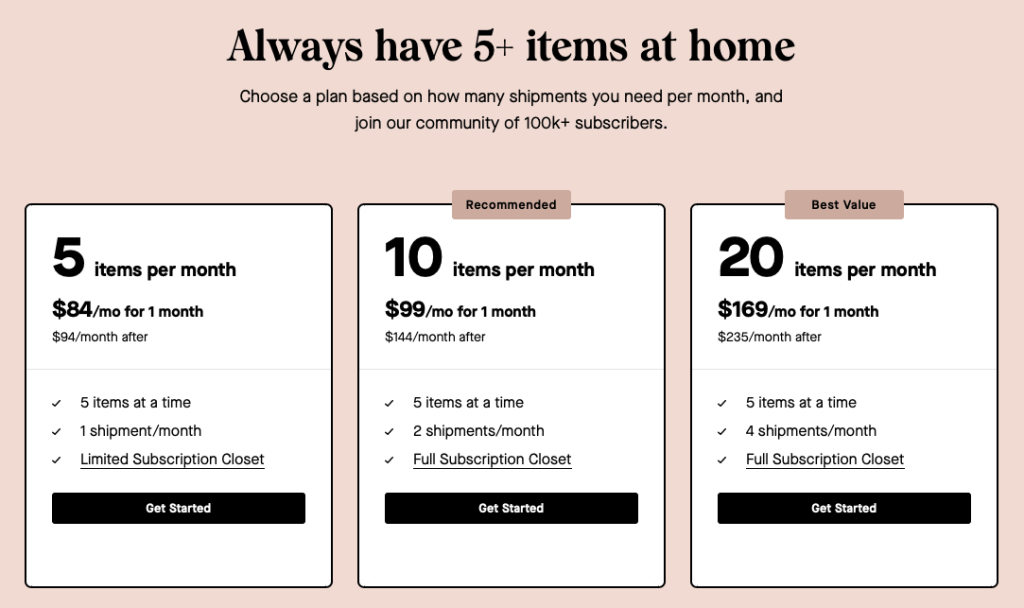
A designer clothes rental online store, Rent The Runway offers three tiers in their subscription model. Each tier is differentiated by the number of items to rent, number of shipments per month, and pricing.
2. Canva
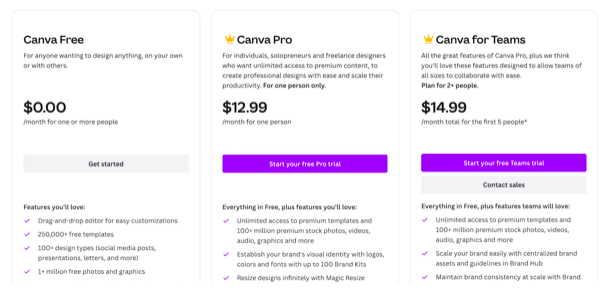
Another example of a tiered subscription model is the graphic design SaaS platform Canva. It offers three subscription tiers differentiated by the features offered, the number of designs and templates that can be used under each tier, storage space available under each level, and other features.
3. Porsche
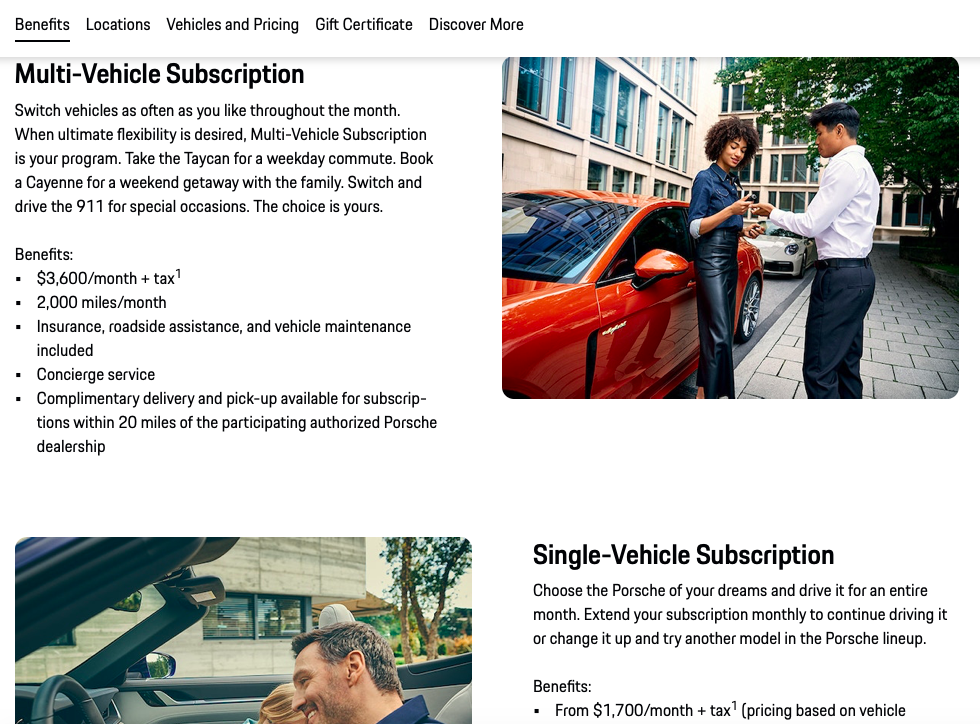
Luxury car brand Porsche too offers subscription plans. Under its single-vehicle and multi-vehicle subscription plans, customers can rent cars, offer services such as car pick up and drop, insurance, vehicle maintenance, roadside assistance, etc.
Key metrics to track for tiered subscription performance
Measure these metrics on a continuous basis to understand what’s working and what needs optimization in your tiered subscription plans.
1. Tier-wise conversion rate
By measuring tier-wise conversion rates you can identify the tier that attracts most subscribers. This can help you optimize your subscription model to make it more profitable. For instance, you might need to optimize your subscription positioning, messaging, feature or benefits allocation to ensure your most profitable tier brings results.
2. ARPU by tier
By measuring the average revenue per user, you can know the revenue from each tier. This can help you understand and identify the most profitable tiers and how revenue generation is distributed. You can understand your higher and lower tiers and whether or not you should optimize any tier.
3. Churn by tier
This metric tells you how many subscribers are canceling in each tier. By measuring the churn rate of each tier you can know whether or not you need to put effort in retention strategies and in which tier.
4. Lifetime value comparison across tiers
This metric tells you the total revenue a customer generates throughout their lifetime with your brand. This helps understand which pricing levels are attracting most customers. You can even understand the customer acquisition cost for each tier. This helps in budget allocation and pricing strategies.
How tiered subscription models evolve over time
Brands do not have to launch a full-fledged, complicated tiered subscription model at the beginning. Rather, take it step by step and evolve over time. Here’s how:
1. Launching with fewer tiers, expanding later
Many eCommerce businesses launch subscription models with fewer tiers. This can help test the waters, avoid overwhelming customers, and help gather data that can guide you in understanding what your customers want. This way, you can start lean and keep enhancing your subscription program over time, based on customer preference and demand.
2. Testing pricing and benefits per tier
Brands can and should keep experimenting with different pricing strategies and price points to identify the best pricing that works for both the customers and the brand. For instance, think A/B testing, regional pricing strategies, and periodic price adjustments based on customer feedback, product demand and supply, etc.
3. Seasonal or limited-time premium tiers
Brands can also introduce subscription tiers for a limited period or seasons. This helps create urgency and generate additional revenue. For example, these could include holiday themed packages, back to school packages, or other exclusive and limited-time tiers.
How to get started with a tiered subscription model in eCommerce?
Tiered subscription models are growth engines, not just pricing methods. Tiered structures help brands strategically monetize different tiers, enhance customer engagement to increase CLTV, and grow the business over time as your subscribers grow within the tiers.
To get started and manage a successful tiered subscription model, you need a smart partner, such as Appstle Subscriptions App. The app is designed to help Shopify and Shopify Plus brands set up a custom subscription plan, automate tasks, enhance tiers via built-in marketing features, collect and analyze data from across the tiers, and much more.
Getting started with a tiered subscription model for your Shopify business is easy. Appstle Subscription app can help you build a custom subscription model for your business.
The app is designed for Shopify and Shopify Plus stores to provide the ease of setting up different types of subscription programs, including tiered subscriptions.
With built-in loyalty features, flexible billing, advanced analytics, excellent customer support, and assistance from expert teams that help meet business goals, Appstle Subscription is the most preferred subscriptions app for Shopify retailers.
Explore Appstle Subscriptions and reach out to our experts today.