
TL; DR
- Traditional points-based loyalty programs on Shopify stores are failing because they’re too transactional, offer hard-to-redeem rewards, and lack differentiation from competitors.
- Discount-heavy eCommerce rewards programs erode profit margins, train customers to expect constant deals, and create no emotional connection.
- Better alternatives include tiered systems that create status and aspiration (Silver → Gold → Platinum), experiential rewards like exclusive events, workshops, or VIP access, and personalized offers based on individual customer behavior.
- Don’t abandon points entirely—combine them with exclusive perks, focus on long-term retention over transactions, and offer redemption options beyond discounts (exclusive products, experiences, charitable donations).
On average, every consumer belongs to around 13 to 15 loyalty programs, but they actively use just a couple. That’s because most loyalty programs focus only on points. And points are no more enough to engage customers.
Today’s customers want experiences that go beyond transactions, they want to feel connected with brands, and want something more valuable.
So why is it that Shopify points-based loyalty programs do not work? And what can you do instead to make your loyalty program more engaging?
Let’s find out!
Why do points-based loyalty programs fail on Shopify stores?
With increasing competition in the eCommerce rewards industry, it’s hard to sustain programs with points alone. Here are the three most common reasons why points-based loyalty programs on Shopify stores fail so often.
1. Rewards are too hard to redeem
Redeeming reward points is easier said than done. Most brands make it hard for customers. For instance, either there is a condition applied, or customers need a specific number of points to be able to redeem them, or there’s some other limitation.
Customers end up feeling frustrated and hassled when wanting to redeem their points. And when something like shopping becomes hard for customers, they lose interest.
2. Lack of meaningful rewards
Another reason Shopify points-based loyalty programs fail is because the perks are not meaningful for customers. While you may be offering huge discounts and double or triple points, what is it that your customers want? Do they want points or something else?
Basic rewards such as free gifts, a discount voucher, or free shipping are not enough to attract or engage customers. Successful loyalty programs offer rewards that customers value and cannot get easily from other brands. But most brands make rewards feel like afterthoughts.
3. Customers see no difference versus competitors
Every eCommerce brand offers points towards purchases. And the points structure of all brands is almost the same. Customers do not see any difference in the loyalty program of one brand from the other.
Creating loyalty programs just for the sake of creating them does not provide a competitive advantage. Moreover, customers feel no emotional attachment just by earning points. They end up only engaging transactionally.
The problem with discount-centric rewards
Points based loyalty programs in Shopify stores may have benefits, but there are many problems with it. Here are some of the issues with discount-centered loyalty programs.
1. Discounts erode margins
Whether you give a 10% or 15% discount, it means your revenue is decreasing by that amount. For businesses offering more discounts (25% to 30% or more), it can add up to a significant amount of getting deducted from the revenue.
Thus, when you continuously offer such discounts, you are training customers to expect those prices always. This way, you end up making less money from your most frequent buyers. This can be harmful for new Shopify brands that are yet to make profits.
2. Customers expect more discounts over time
Discount-based loyalty programs create unreal expectations. For instance, if customers receive 10% off with every purchase, it becomes their baseline. They expect a 10% discount with every purchase.
Moreover, their expectations keep increasing, and they look for higher discounts with every purchase. Brands that try to meet this customer expectation face rising costs of offering discounts.
3. Loyalty becomes transactional, not emotional
When you design your loyalty program on transactional incentives, it’s hard to create brand advocates out of your customers. These customers don’t remain loyal to brands once the financial incentives are taken away. They do not feel any emotional connection toward the brand. Customers who have meaningful experiences with brands often tell their friends and become brand advocates. But only transactional experiences fail to engage customers.
Alternatives to Shopify points-based loyalty program models
Designing eCommerce rewards programs that go beyond points can take your brand experience from mere surface-level engagement. Here’s how you can create other types of loyalty program models:
1. Tiered rewards systems
Tiered loyalty programs add elements of gamification to loyalty programs. Tiered programs engage human psychology by making members want to climb higher tiers, providing a sense of status and achievement. For example, when customers move from silver to gold to diamond tiers, it not only gives them better rewards, but also an emotional sense of achievement.
Here are some tips to follow:
- Distinguish each tier from the other by designing different perks for each level
- For example, Silver members get early access to collections, Gold members get fast delivery and exclusive access, and Gold members get personal shopping assistance, invitation to events, and first access to limited editions
- Make each tier feel aspirational by including a unique benefit. Members should know where they stand and where they want to reach
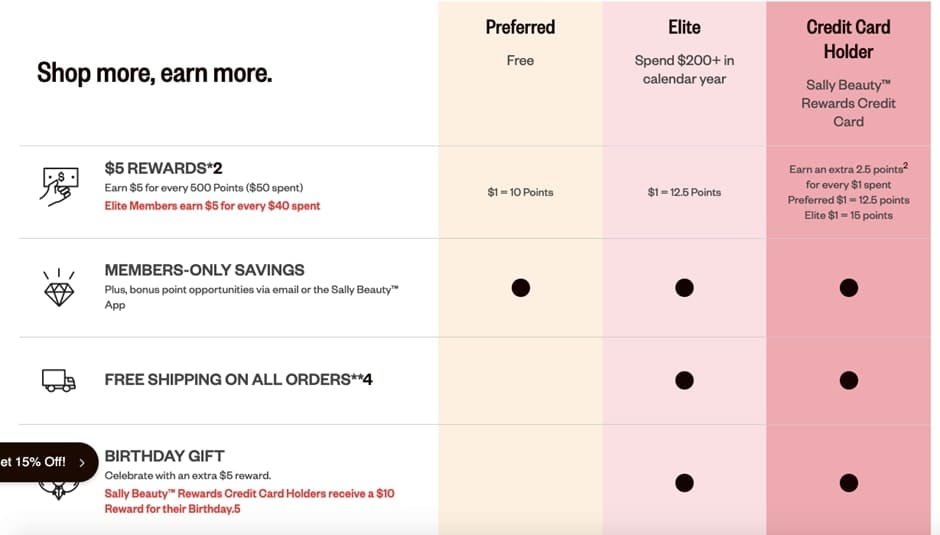
Example: Sally Beauty Club’s tiered rewards program
2. Experiential rewards
Every brand offers points as rewards, but some brands go above and beyond to offer memorable experiences. According to a McKinsey study, emotional loyalty drives 82% higher customer retention compared to transactional programs. So what are these aspects that stir emotions into loyalty programs?
- Exclusive and VIP shopping events only for loyalty members
- Offer access to your top most tier before other levels get access
- Organize virtual or in-person meet and greet events for members
- Create experiences that educate and engage, such as workshops
- Collaborate with other complementing brands to create unique experiences
- Example: Lululemon, the athletics brand, offers free yoga classes and facilitates running clubs for its members only
3. Personalized offers tied to customer behavior
Customers’ preferences differ based on their needs. And so, if you apply a one-size-fits all approach when offering rewards, it doesn’t bring the expected results. The solution is to personalize rewards based on customer behavior. Here are some ways to do so:
- Analyze purchase history, browsing behavior, and loyalty program engagement patterns to create hyper-relevant rewards
- When customers make repeated purchases from a specific category, offer them early access to new products in the category
- If customers shop more during a specific time of the year, plan your outreach and promotions accordingly
- Offer surprise gifts on their birthday or their pet’s birthday
How to reinvent your Shopify points-based loyalty program into an effective model?
Given the ease of using technology, online tools, data, and customer openness to try new things, there are many ways in which you can reinvent your loyalty program. Here are some ways you could consider:
1. Combine points with exclusivity
More effective rewards programs don’t mean you remove points all together. The idea is to offer points so that it can become a tracking mechanism. And along with points, offer exclusive perks, and enable redeeming of points in various ways. For example:
- Allow customers to redeem points against exclusive merchandise, which is not available for regular purchase
- Allow customers to redeem points against entry into exclusive, members-only events and experiences
- Enable customers to redeem points against charitable donations
- Ensure you points represent a lot more than just money or discount
2. Focus on customer retention over transactions
By focusing on increasing customer lifetime value, you can take a long-term approach, instead of one that brings only short-term gains. You can do so by designing rewards that increase purchase frequency, engagement, and longevity. Here’s how:
- Offer anniversary rewards and special perks on the joining anniversary of customers. This way, customers look for annual perks
- Give customers rewards on their birthday. This will make them come back to redeem the rewards
- Offer rewards to customers who have been inactive for sometime, to revive their interest in your brand
- Think of ways to offer surprise rewards to make customers feel that their ongoing relationship matters to you
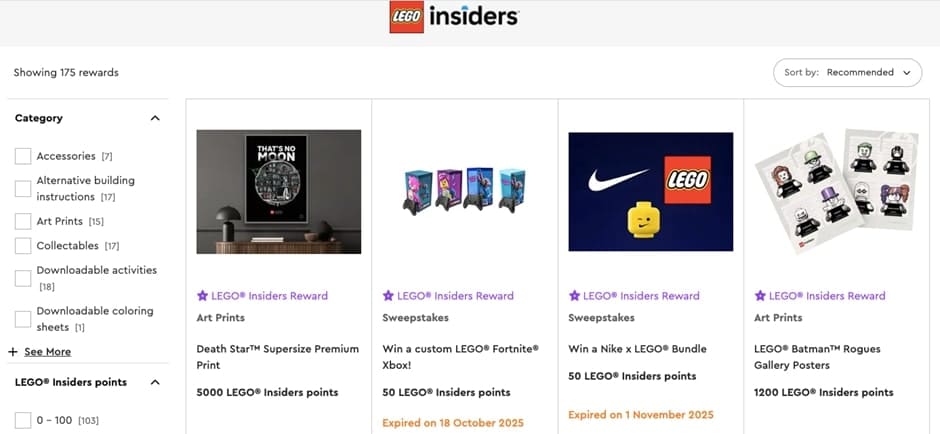
Here’s how Lego engages customers with more than just reward points.
Lego has a loyalty program called Lego Insiders. The program allows customers to display their creativity, sign up for challenges, and learn about designing. The rewards include exclusive meet and greet, factory tours, and more. Members can also submit proposals for new Lego sets as well as vote for ideas submitted by other members.
Key takeaways:
- The brand integrates its members within the brand by allowing them to share ideas for new products
- Offers unique perks and rewards that are more than just points
- Makes the perks interactive, encouraging members to participate
How to integrate points with other perks using Appstle Loyalty & Rewards App
Shopify brands are increasingly using the Appstle Loyalty & Rewards App to set up and manage their loyalty programs. Here’s how the app helps Shopify merchants increase loyalty program engagement, customer retention, and more.
- Implement tiered loyalty programs enabling customers to earn points as well as experience tier-based benefits
- Personalized rewards based on customer segments
- Automate member milestone celebration and rewards
- Offer surprise rewards based on customer behavior
- Integrate with subscription programs
- Combine loyalty and referrals programs
If you’re looking to enhance your existing Shopify rewards program or set up a new one, install Appstle Loyalty & Rewards App on your store today!