
Brands face many issues with eCommerce subscriptions. For example, low sign-up rates, customers fearing long-term commitment, early-month churn, and product fatigue, among others.
If you’re facing similar challenges in your Shopify subscriptions, read this blog to understand how you can offer low-risk subscription plans to your customers.
Let’s get started!
A snapshot of concepts in this article
- First-time subscribers often hesitate due to fear of commitment, hidden costs, and losing control – your job is to eliminate those fears
- Highlight flexibility (pause, skip, cancel) prominently across the purchase journey, not just in the FAQs
- Lower the entry barrier with free trials, discounted first orders, or single-cycle commitments so customers can try before fully committing
- Show clear savings vs. one-time purchase pricing to make subscriptions feel like smart shopping, not a trap
- Use subscription-specific social proof – long-term subscriber reviews and “almost cancelled but didn’t” testimonials build targeted trust
- Give customers control over delivery – flexible frequency options and easy quantity adjustments prevent the dreaded overstock problem
- Be fully transparent about billing – list every charge, date, and renewal term upfront; no vague language or hidden fees
- Reinforce post-signup that everything is reversible – plans, frequency, products — to ease buyer’s remorse and reduce early churn
7 strategies to offer low-risk subscription plans for your Shopify store
If you want to build low-risk subscription plans in your Shopify store and are not sure about how to do so, apply some of these 7 strategies.
1. Prominently highlight flexibility
One of the main reasons customers avoid signing up for long-term subscriptions is the fear of getting locked into something they might regret later. What you can do to reduce subscription hesitation is to let them know they’re not trapped.
Make your subscription flexible by including features such as pause, skip, and cancel. And also let customers know about these features. That way, they won’t feel trapped. And you can improve subscription sign-ups.
Studies show that offering flexibility significantly boosts conversion and retention rates.
But make sure to highlight these features. Here are some tips:
- Make the flexibility features visible at all decision points along the purchase journey
- Don’t write about the features in the FAQs only
- Make it visible on the pricing page, the product page, near the ‘Subscribe’ button and in the checkout flow
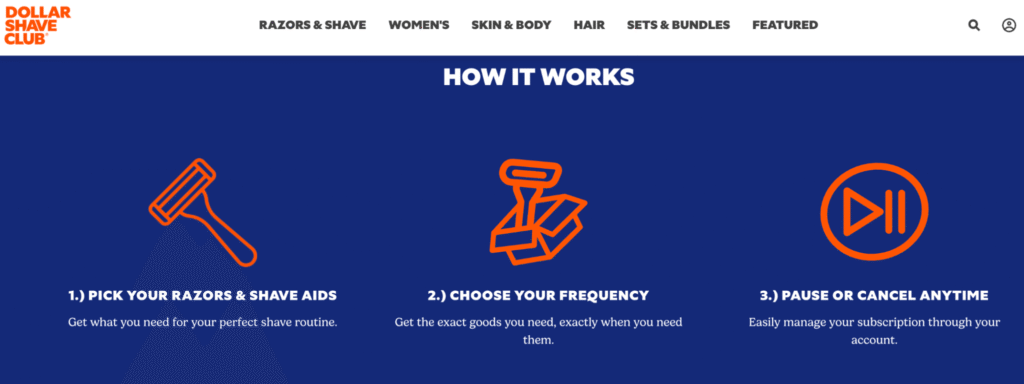
Here’s an example from Dollar Shave Club. The brand mentions the pause and cancel option in multiple places on the website.
2. Offer soft commitment entry points
Customers are cautious when trying new products and new brands. That is why most of them prefer to first buy a small quantity or a smaller pack as a trial. And that’s where trial periods come into the picture.
Here are some strategies to incorporate a soft commitment entry point to create low-risk subscription plans.
Trial periods
One of the best examples for free trials is of SaaS brands – 15-day free trial or 1-month free trial. Offering free trials removes one of the biggest barriers – customers don’t have to pay for something they haven’t tried yet.
Here’s what free trials do – they shift the customer psychology from should I trust this product to should I keep this product? This helps improve subscription sign-ups.
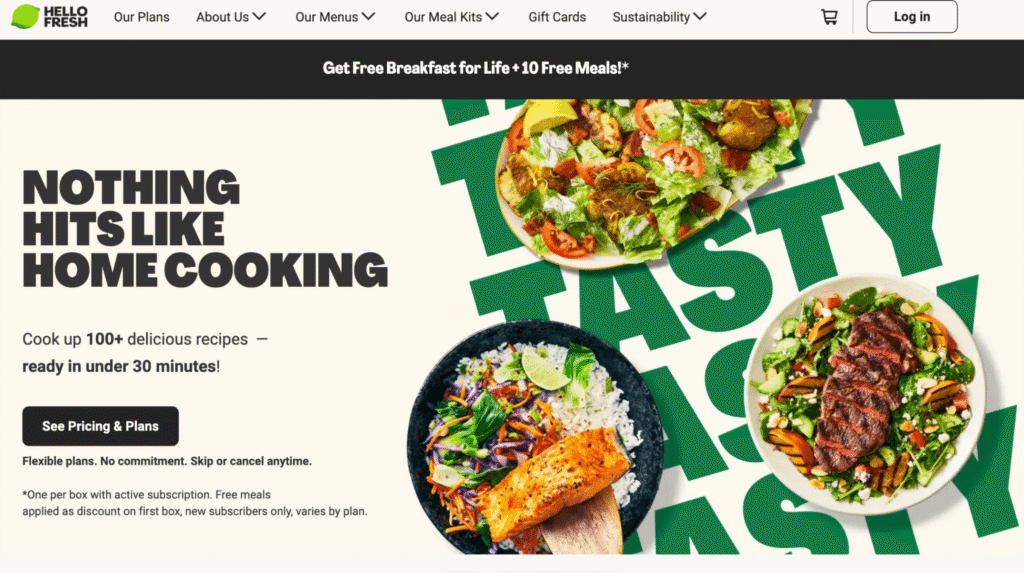
For example, the meal kit subscription brand, HelloFresh offers a discounted first box. Customers get to try the products, and the convenience, and choose to sign up for the long term.
First-cycle-only commitment
Another strategy for making the entry earlier is a single-cycle commitment. For example, “Try one month without any obligation to sign up after that.” This means customers know they can exit after a month. This also reduces customer anxiety.
Another way to communicate this is, “Subscribe today, cancel before your next billing date if you don’t want to continue.” This makes customers feel safe and not trapped.
3. Show clear value comparison vs. one-time purchase
Many brands follow this strategy on their product pages – they show the product price if bought as a subscription vs. when bought as a one-time purchase. This shows customers the price benefit, enticing them to sign up for subscriptions.
Here are some ways to reduce subscription hesitation:
- Show side-by-side pricing tables
- Save 20% when you buy as subscription
- Example: one-time pack: $100, subscribe & save: $85 (Save $15 every month)
When you show savings clearly, the subscription stops feeling like a trap and starts feeling like smart shopping.
Further, also highlight the other benefits, such as free shipping, exclusive access, member-only discounts, free invitations to events, etc. These reveal the real value of your subscription plans.
4. Use social proof specific to subscriptions
While you might have generic reviews and social proof on your website, adding subscription-specific social proof can impact how new customers perceive your plans. Why? Because it answers their key questions, and builds trust. And improves subscription sign-ups.
Social proof is a key trust signal for eCommerce subscriptions. Here’s what you should do to create low-risk subscription plans:
Show reviews by long-term subscribers
- Pick and highlight reviews by subscribers who have used the subscription plans for a long time. For instance, reviews such as, “I’ve been a subscriber for a year, and I’m always happy with the quality.”
- Use your Shopify subscriptions app to tag and filter reviews, and automate sharing. This makes your repetitive tasks easier and more targeted.
Show retention testimonials
- Ask for testimonials from subscribers who were on the verge of cancelling but chose not to. These testimonials can persuade non-subscribers to sign up. It shows that subscribers have the flexibility to cancel anytime.
- Automate the process of requesting testimonials with the help of your subscription platform.
5. Remove the fear of overstocking
Many customers sign up for subscriptions and soon realize that they have surplus stock. This happens when subscription frequency cadence is not flexible. For instance, a coffee subscription with a monthly plan. Subscribers may not end up finishing coffee every month.
This fear of overstocking keeps customers away from subscribing to new plans. But this barrier has a solution. When customers feel in control, they are less likely to cancel subscriptions. Here’s what to do:
Flexible delivery
- Create a structure that allows customers to choose their delivery frequency
- Make it easy for them to change delivery frequency
- Create options of 2 weeks, monthly, every 6 weeks, etc., for their convenience
Easy adjustments
- Allow customers to make easily quantity adjustments
- Make the process of making adjustments easy and quick in a few clicks
- Allow customers to reply to delivery emails to make such changes
- Send reminder emails, such as this: “Your next delivery is in 7 days. Email to delay, skip, or adjust quantity.”
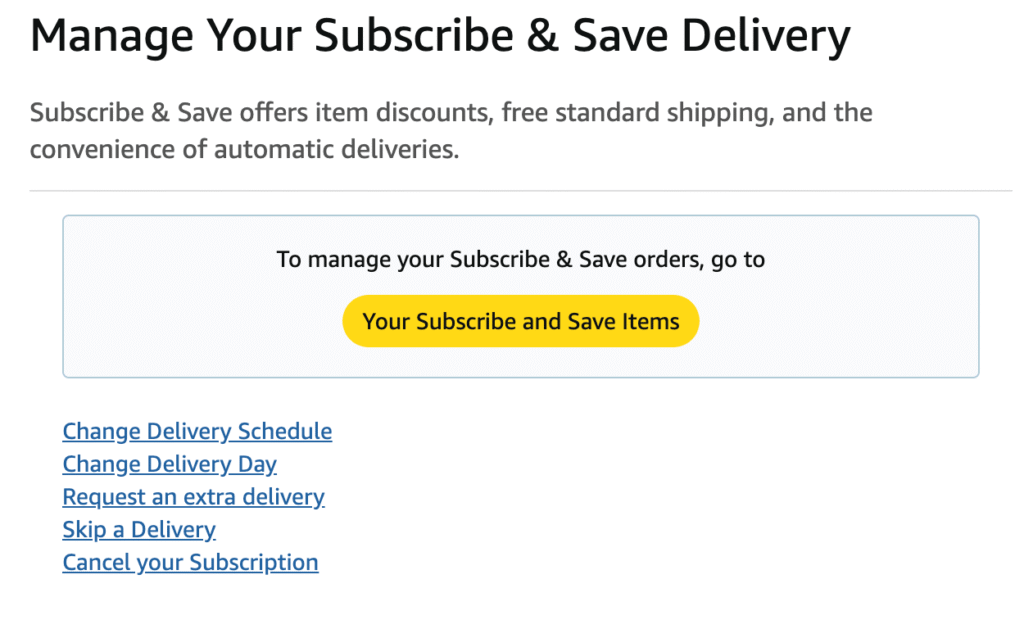
For example, Amazon’s Subscribe & Save lets customers choose delivery frequency from a dropdown, and change it at any time.
6. Provide clear billing expectations upfront
Hidden costs and billing surprises in subscriptions are the biggest factors that destroy trust. The result is cancellation. But if you let first-time subscribers know what they’re signing up for and what they’ll have to pay, you can lay the foundation of trust from the start. The result: low-risk subscription plans.
A report by Harvard Business Review reveals that upfront disclosures about pricing and costs increase purchase interest and foster lasting psychological safety. When customers know exactly what they are paying for, they tend to spend more and refer others to the brand.
No hidden charges
- List every charge clearly at checkout: the subscription price, shipping fees, applicable taxes, and when the first charge occurs, etc.
- Don’t use vague language like “additional fees may apply.” Be specific.
- For example, Monthly subscription: ₹999, Shipping: Free, First charge: Today, Next charge: June 20, 2026
Avoid confusion about renewal
- Explain renewal terms in plain language
- For example, “Your subscription plan will renew automatically on the 30th of each month. You’ll get an email and WhatsApp reminder 7 days before. You can cancel or modify it anytime.”
7. Reassure customers they can change plans anytime
It is common for customers to feel doubtful and have anxiety after signing up for subscription plans. They wonder if they’ve made a wrong decision, chosen a wrong frequency, or the right products. You can address these to reassure them, which can lead to low-risk subscription plans. Here’s how to reduce subscription hesitation:
Emphasize the reversibility of decisions
- Make it clear in your post-purchase email, in your onboarding flow, and in your account dashboard that nothing about their subscription is permanent.
- They can upgrade, downgrade, swap products, or pause at any time.
- For example, “Sign up today, change your plan, swap products, adjust frequency or pause, or cancel anytime.”
- Add a ‘Manage my subscription’ shortcut to every email you send to subscribers.
Summing up: Make subscriptions low-risk for your Shopify customers
First-time subscription buyers often fear being trapped. And that is why you need to think of creating low-risk subscription plans for them. Focus on flexibility, lower entry barriers, build transparency, and address their key problems.
To set up a low-risk subscription plan you will need a smart partner in your Shopify site. Appstle Subscriptions App offers a set of comprehensive features. The app has built-in capabilities for marketing, automation, automated data reports and analysis, cancellation management, etc.
Install Appstle Subscriptions App in your Shopify store today!